scientific and technical website design projects news

Articles on website design

Post pictures in Twitter

Something new – you can now add pictures to your Twitter items, I immediately looked at this with one of our clients (Mobility Nationwide), to put thumbnails of some of the wheelchair accessible vehicles onto the feed – I’m not sure a picture is worth 1000 words, but it certainly helps describe the product alongside the 140 characters you have as standard!

Mobility Nationwide’s twitter feed

The WordPress CMS

WordPress cogs We’ve used WordPress for many years now to manage news sections of websites, where its ‘pile ’em up’ approach to managing stories, and simple user interface has allowed many of our clients to take over day-to-day management of this section of their website. Over the last year or so, however, there have been significant improvements under the WordPress hood. Most recently we’ve seen the introduction of the graphical menu management system, which we think is a pretty strong contender for killer ap status amongst CMS systems…

The new menu manager lets the site administrator drag and drop new pages to where they are wanted in the site hierarchy. Further, you can change the way the link appears in the menu – retain or shorten the page title? add some hot text to hint to vistors? – can do!

The new TwentyTen templates also make good use of style sheet (CSS) properties to build fly-out menus that use no Javascript. This is quite a cool trick, and whilst it is getting more difficult to surf the web without Javascript, it is a safer way to travel, so we prefer to leave it out of essential services – like the menu!

Simple things to make for a more pleasant browsing experience!

A problem with fly-out menus is that they often leave you with no idea where you are in the site hierarchy. This can be a real pain if you surf into the middle of a large site using a link from elsewhere. The page looks interesting, but it lacks any context – where am I? Where do I go next? To avoid this on the new Lochaline Dive Centre website, we looked at adapting the TwentyTen menu code so that active sub menu’s are held open. Peace, I can arrive at any page in the site and see clearly where I am… Simple things to make for a more pleasant browsing experience!

Most CMS systems restrict your freedom to build sites, pushing you to do things their way, rather than giving you the freedom to build what you want. This results in a definite feel for the way they work – done well it need not be clunky, but still the underlying CMS imparts a flavour to your browsing experience… What is really impressive with the new WordPress system, however, is that you would need to check the web address window in your browser to realise that you are not in a custom built website. Indeed, there are very few changes to the Lochaline Dive Centre website due to its move to the CMS, what changes we have made were done because it is now so easy move pages within the site structure. This has given us the freedom to re-order content to try and put together a more user friendly site.

That is how it should be…

Homework diary (iCal)

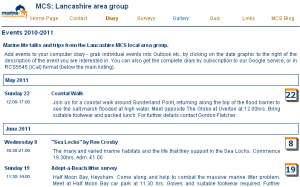
MCS diary screen-shotWe’ve just updated the MCS Lancashire diary to output events in iCal format, so that visitors can save event details to their personal electronic diaries. The new version allows visitors to download individual events in iCal format, or the entire current diary. There appears to be a problem with Outlook v6, however, that means it only imports the first event in the complete download…

We also created a public Google diary based on the iCal output, I guess it opens the question of whether or not it might have been better to have simply output this to the site (but then the Google calendar isn’t very pretty…)

MCS Lancashire’s new diary

The cookie crumbles (UK and EU websites)

EC cookieNew EU legislation is to regulate the use of cookies online. Cookies are ubiquitous, but on most sites the use of cookies is quite innocuous, commonly they are used:

  1. To track logged-on members, the cookie identifies your visitor and confirms that they have logged in, and are entitled to view a given page.
  2. To remember what visitors have looked at – allowing the site to maintain a back history (this might be ‘previously you viewed the following items’, keeping track of a shopping basket, or smart behaviour, such as only showing the introduction to a movie or animated display once).
  3. To track what users did on your site, possibly passing this information on to a third party. Whilst the information is ‘anonymous’ – the visitor is usually only identified by their IP address* – with enough linked sites a commercially useful profile of your visitors can be built up.

At CookandKaye we don’t use option 3 above, which is the one that is causing legal concern, unfortunately options 1 and 2 will also be caught by the proposed legislation. As a consequence, you may need to look at your existing web provision. Whilst prosecution is not imminent for any site, we recommend the following policies to cover this possibility:

With login forms: We recommend a comment to be added below the login form, to the effect:

To access this section of the site you must permit us to save a digital key on your computer called a cookie. This cookie will not be used to track your browsing history.

With shopping baskets: ICO says that if a cookie is essential to permit an activity, no consent need be obtained. In spite of this we recommend a comment to be added below the button to the effect:

To save an item to your shopping basket you must permit us to save a digital key on your computer called a cookie. This cookie will not be used to track your browsing history.

Clearly if you do use cookies to track browsing history (not everybody has the refinement to be a CookandKaye client!), the text in italics should be replaced with a statement to that effect! If you are able to add this text, however, then it provides you with an opportunity to re-assure your visitor.

With smart sites: Here the problem is a lot more difficult to solve satisfactorily, as the objective is to help the site run smoothly, not pop up warnings that it is about to save cookies on your browser. Unfortunately these just look like you are trying to do something dodgy, and are likely to damage your relationship with the visitor, rather than match your intent of offering them a tailored service. ICO has not yet published its guidelines, so for the moment we suggest placing a note in your footers to the effect:

Cookies are used on this site to help personalise the browsing experience for you. No information about your browsing history is taken from them.

If you do acquire browsing history, you need to seek legal advice here!

If this proves inadequate in the light of ICO’s final recommendations, then you will need more extensive work on your site. Our work-around at present is to track visitor’s IP addresses rather than use cookies – where this is permitted by your host. When a visitor requests a web page, the page is sent to their IP address, so a record of this is essential. In consequence it is difficult to imagine a reasonable legal challenge to holding this record. It also has the advantage of working whether or not visitors enable cookies! Unfortunately it is more difficult to implement, and there is a small possibility of mis-matching IP addresses and visitors because IP addresses are re-used. As a consequence the time window for tracking is quite narrow – of the order of a few minutes. This is good enough to follow a visitor from one page click to the next, but not safe enough to hold shopping cart information!

We don’t think there is anyone in the web-design industry who supports the new legislation, which, paradoxically, may oblige us to capture more detailed traces of IP addresses, if not actually save cookies on visitors’ computers. In the UK there is some reluctance to introduce the legislation, and a sizeable breathing space is being allowed for us to get ourselves organised to meet its requirements. Unfortunately we have to live with it, and we need to start living with it now. If you need help implementing any of these guidelines on your site please contact us.

More information is available through the BBC – see article linked below:

Websites told to ensure cookies comply with UK law (includes a link to ICO’s current guidelines).

* More clearly private data – linking the IP address/browsing history to a person’s name or physical address, which you might be able to do after your visitor has logged in, is already restricted under the data protection act – there is a good review of this on the BCS website:

Data Protection Act 1998 overview

Cookie crumbs: Update August 2011

bbCareers

bb careers logo

bbCareers is a new business that aims to help people facing an uncertain career future. The new company offers 1:1 tailored support to help clients re-evaluate their life prospects, and get to grips with the nitty-gritty required to ensure they get the job and life prospects that we all want!

bbcareers banner

The project was built in WordPress, and employed the latest features available in the 3.1 templates. Many of the client’s own photographs are used in the site banners, and these can be switched or added to by the client. This allows the website to match the range of images shown on the client’s business cards (printed by Moo). The graphic bb logo (also developed by us) is superimposed on the main banner graphic, so the client does not need to worry about adding this to a new banner before it is uploaded.

There is a clear need for this type of careers help in these uncertain times, and we wish Bridget and bbCareers every successin the future!

bbCareers – careers advice for grown ups

WordPress comments are closed!

Spam and chips We’re closing the comments section on CookandKaye.com, because of the volume of spam and phishing attempts we’re getting through it. As Google descends into the morass of social network link-counting, any half way decent blog is getting innundated with linked comments advertising this and that, without usually even a glance at the article to see if the comment is relevant…

Much of this stuff is filtered automatically by Akismet, but we realised last update that we were carrying over 2MB of trash comments in the database, rather outweighing the rest of the blog contents, images and all. It was simply taking too long to work through the comments to pick out the good stuff…

So, sorry to any genuine commenters, but if you really like what were doing, please let others know through the new Twitter link being rolled out on all of the project articles, or through a ping-back from your own blog. We’ll try to reciprocate any pingback that we can sensibly work into our output!

If you want to contactus for more information about anything we’re doing – you’ll find a new email link under each post as well.

Redstone website

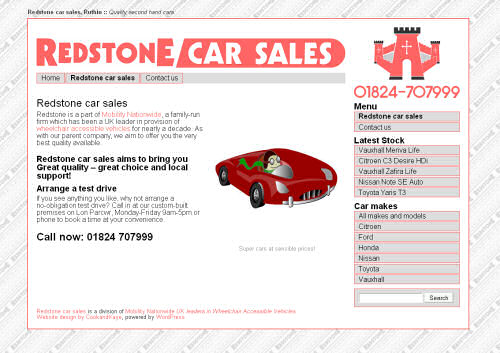
Redstone Car Sales Ruthin screenshot.

Redstone car sales, Ruthin, hasĀ  a new website. The design of the site draws on the history of Ruthin, with it’s sand stone castle providing a symbol of security in difficult times! We built the site in WordPress, to give Dave at Redstone a simple and cost effective means of adding vehicles to the world wide web.

Redstone is a part of Mobility Nationwide, a family-run business which has been a UK leader in provision of wheelchair accessible vehicles for nearly a decade.

Why you should use open source

OK, I won’t say that all database companies are like this, but CA Technologies are suing people who make software that allow their users to migrate to different database solutions. So what will you do now it is illegal to take your data elsewhere? I might say that the people moving data were a bank, so I guess we shouldn’t expect too much foresight in the first instance, but the first rule of business guys is to ensure that there is a plan B (or never get cornered in the marketplace)!
Original article in IT News by Ry Crozier on Nov 26, 2010, via Slashdot (see this for more comment).

Full story in IT News

IKUWA3: from the archive

Logo of IKUWA3: The Third International Congress on Underwater Archaeology

We have recently restored the Third International Congress on Underwater Archaeology (IKUWA3) website, to provide support for IKUWA4. The site has been re-built within the NAS domain (five minutes work, restoring straight from our archive!)

A new website for the Civic at Barnsley

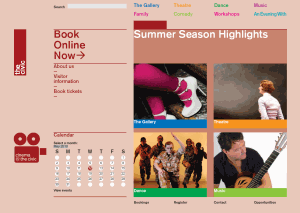
The Civic home page view.

The new website for the Civic at Barnsley is yet another demonstration that a site in Joomla! (an open-source Content Management System) does not need to look bland. The site is based on the printed material designed for the Civic by Eleven Design, and follows the layout and colour schemes developed there pretty religiously.

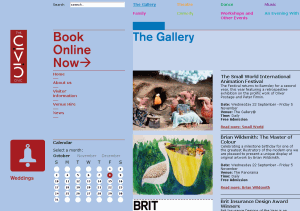
This has resulted in a colour-coded site, with each major category of events in its own distinctive page background scheme. To do this we had to develop some pretty complex templates within Joomla! – which detect the type of page, and display it in the correct colour scheme.

We developed a Flash-based home page (screen-shot above), which rotates through the planned calendar of shows. This is a feature is sometimes seen on national theatre websites, which are working with very much larger budgets, and we had to sweat blood to build it within budget here. As ever, for Flash content, we have a text-and-image alternative for iPod users (if it wasn’t for the fact that this alternative content is also useful for non-visual browsers, I’d say it was a case of 3% of visitors wagging 97% of dog!).

Civic website screen shot from the Gallery section - in blue.

We had a good hunt for a decent calendar to run within Joomla!, but without luck. So we were obliged to develop this component from scratch as well. To reduce development costs and stay within budget we integrated the development with that of the home page display, this had the additional advantage of eliminating the need to re-key data into the system for both items. The default view for the calendar is again a Flash application – which is pretty (click on a date to see what events are happening), but I’m not sure the non-Flash view isn’t more useful, as this provides a list of up-comming events and when they are due to happen, but I guess you get this latter view when you click on the calendar link anyway…

Next up for the Civic is to try and get the Ticketing system so it looks something like the rest of the site. The templating system for the commercial software that runs the ticketing system is bloody awful, unfortunately, so we’ll be struggling to get much out of it… (That will be the subject of another post, or possibly a rant, as so far working on it is has caused hair thinning and cardiac arrest. This is, however, a salutory tale for anyone who thinks that open source systems are inherently ‘worse’ than commerncial systems – believe me it aint the case, Joomla! is open source and well stuck together…).

Anyway, if you fancy a night out in the Barnsley area, why not visit the new Civic site to see what is happening?